

Community Bank M&A Strategy: A conversation with Wayne Bank CEO Jim Donnelly who led the acquisition of Presence Bank with a culture-first integration approach.
Catching up
I finished my lunch, brewed my final cup of coffee and logged on. The Philadelphia area had just strung together three straight days of 75-degree weather in early March. So naturally, it began to snow just as Jim Donnelly, President and CEO of Wayne Bank, joined the call.
He was back in his office in Honesdale, PA, surrounded by pictures of his family. His hair had a little extra silver compared to the last time we spoke, but he had a little extra spring in his step too. Fresh off a networking tour of the banking investor scene in Chicago, he was ready, as always, to nerd out on culture and leadership. This time, the subject was Wayne Bank’s recent acquisition of Presence Bank.

If you don’t know Jim Donnelly’s story, the short version goes like this. Brooklyn kid, working-class roots, father worked the Staten Island Ferry, mother kept the books at a law firm. He ended up in Maine, got elected to the state legislature at 23, one of the youngest in the country that year, and parlayed a management trainee gig at KeyBank into a decades-long career at the top of the community banking world. Today he runs Wayne Bank and its parent company, Norwood Financial Corp. (ticker: NWFL), out of Honesdale, Pennsylvania. He reads about the 1929 crash for fun. A complete banking nerd with a kind heart wrapped inside a savvy Brooklyn smirk.
Culture Was at the Front of the Conversation, Not the End
Wayne Bank was founded in 1871, and in 2010 the bank grew to roughly $300 million in assets. Then through a series of bolt-on acquisitions and steady organic growth they were nearly $2 billion by the time Presence entered the picture.
In short, the numbers made sense. But Donnelly will be the first to tell you that numbers might be the starting point, but they are not the story.
He opened our conversation by referencing Jack Welch‘s writings on culture in acquisitions, specifically a deal where the cultures never fused and the organization never found its footing.
“In one of his books, he talks about the worst acquisition he ever did, and that the cultures never fit. They never really got that esprit de corps going that you want to get going after you do the combination. And he said it was because the cultures were so different at the core.”
Donnelly and Janak Amin, the then-CEO of Presence Bank, had been circling each other professionally for a couple of years. They both served on the CDIAC for the Philadelphia Federal Reserve and were board members at the Pennsylvania Bankers Association. They were quite friendly and respectful toward each other. They had the kind of relationship where you actually listen when the other person talks.
Then the investment bankers started whispering.
“Investment bankers also came up and said, what do you guys think? And you start to look at the numbers, and the numbers are appealing. And Janak and I had lunch a few times. So it was a long process. But what did THEY say? An overnight success, two years in the making.” Donnelly said.
The secrecy that surrounded the early stages was, of course, required. Two publicly traded companies can’t tip off the market while they’re still dating. Donnelly laughed describing how he and Amin once had to navigate a public event, ducking to a back table so nobody would see them talking.
We were at an event where we mapped different ways to find this back table somewhere where nobody would see us chatting as we were trying to get a framework for what would work.”
An important part of defining aligned cultures comes when you get people involved who understand what makes both parties tick. So, they also had dinner with their significant others. And on the drive home, both wives independently said the same thing: they liked the other couple. They thought the two men were great together.
“You know,” he told me, “It’s always somebody who knows you really well. You leave the dinner; you get to hear what they [the spouse] saw at dinner that you may not have.”
Eventually they got to NDAs and board-level meetings. But the cultural conversation came first.
That sequence of events was very intentional.
White Gloves and Red Ribbons
Here’s something you don’t hear every day in a bank merger debrief. The acquirer looked at the target’s deck and thought “I want to be more like them.”
Presence Bank had a term for their customer service philosophy: white glove service. When Donnelly reviewed Amin’s internal materials, he didn’t see a smaller bank he was absorbing. He saw something to emulate.
“He gave me a deck and I’m flipping through that. I’m like, this is either where we just came from or where we want to go. And it seemed like bringing them in would improve our culture and help take us to the next level rather than us rescuing a smaller bank.”
Wayne Bank has its own version of this philosophy. Donnelly calls them “red ribbon moments.”
“How do you tie that little touch or card you drop with a little red ribbon that says this is special and you’re not a number here.”
Here are two banks with the same instincts, using different language. That kind of instant alignment is unique, and he knew it.
The 80% Didn’t Get to Dictate the Terms
This is where Donnelly departs from the conventional M&A playbook, and he does it deliberately.
In most acquisitions, the acquiring bank essentially tells the smaller institution: here’s how we do things, welcome to the family, good luck. The logic is size. If you’re 80% of the combined entity, your systems, your processes and your culture usually win by default.
Donnelly rejected that framing completely.
“My instructions to our team, and they took it to heart, was we should be a better bank when we get done with this. So don’t assume we’re doing it better. They explore which way is better. If they have a better policy and or process, let’s adopt it. Let’s find the best of each bank and put it together to make the combined bank better.”
He wasn’t just saying it. He backed it up with action. Presence Bank has a superior credit underwriting system. So, Wayne Bank is migrating to their system, not the other way around.
“We want to be a better, stronger organization. So just taking what one was isn’t enough. You have to take what’s best out of both.”
That one move changed the psychological dynamic of the entire integration.
If that philosophy exists at the lower management levels, this will mean Wayne Bank is living the “hire great people and don’t tell them what to do but listen to them” mantra that is paraded around every social media page related to leadership these days. I can’t imagine what an amazing future this bank has on a department-by-department basis.
He laughed and leaned into it.
“When we get a new system in, one of my quirky little sayings is: we just bought a Porsche, don’t put our old Jeep tires on it. Our policies and procedures need to match the capabilities of the new tool. Otherwise, why did we buy it?”
The Announcement Day No One Has to Dread
Anyone who has been through a merger knows that announcement day is often the worst day for employees. Rumors spread faster than facts. Social media fills the vacuum. Anxiety becomes the dominant currency. Everyone’s thoughts immediately (as they should) go to “am I going to be ok in this? Is my family going to be ok? Do I even fit into their plans?”
Donnelly’s approach was to shrink the window of uncertainty as aggressively as possible. He and Amin worked quickly to determine a plan, one way or another, for every employee. They told people quickly and directly, even when the news wasn’t what they had hoped for.
I think it’s a lot kinder to give somebody certainty, even if it isn’t the answer they hoped for. It’s the right thing to do and it’s how we want to drive culture.”
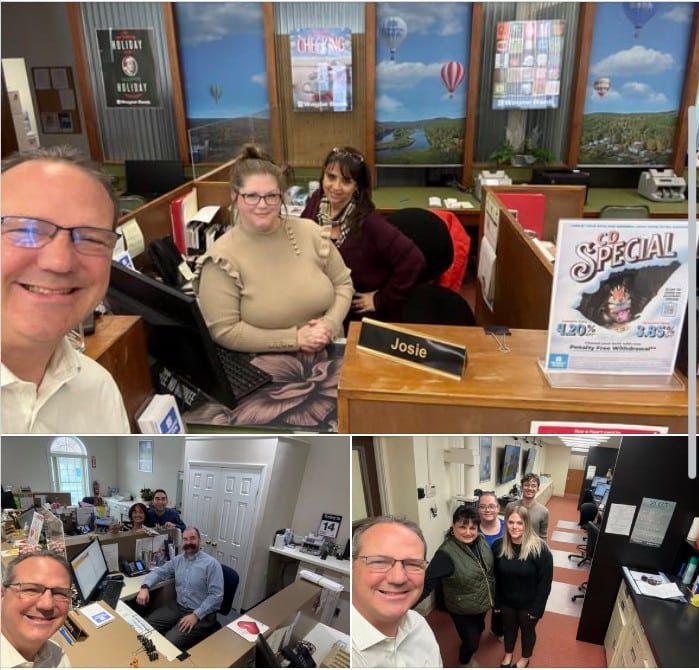
Donnelly met with employee in small groups, not a big setting where people would be uncomfortable asking questions. He also had one-on-one meetings with employees to understand their concerns upfront if they had any. He invited them to ask the uncomfortable questions. Some of the meetings ended with laughs and others with tears of relief as we assured people of the process and kindness we were going to use in dealing with each employee.
Those moments, usually quiet and not part of any press release, can tell you more about a bank’s culture than any tagline ever could. Culture appears in the actions taken when the choice is between profit and people. And in those moments, actions are the only things that matter.
No One Falls Behind on Day One
The most pressure-filled situations in any system conversion is the moment a customer walks up to the window and asks a simple question that the employee used to know cold. That little gap, that half-second of uncertainty, is where trust either holds or starts to crack.
Donnelly thought about that carefully and smirked.
“So, we’ve set up an ambassador system. We’re going to have our employees embedded at each of the locations. Our call center is prepared to back them up. And then we’ve assigned each employee a buddy. Somebody that they can call that’s not their boss to double check.”
Assigned a buddy, not their boss. That intentional move shows the meaningful difference between asking your manager something you feel you should already know and calling a peer who is simply there to help you through it. Donnelly understands that distinction. He drives culture by not shaming people but by giving people the tools to grow.
The approach is layered. For the first four to six weeks, a dedicated person is physically present at each location walking employees through the new system in real time. Then that person steps back, stays close and lets the employee do the work while support remains available just over their shoulder. Wayne Bank is also rotating team members into the Presence markets nearly every day to stay visible and accessible.
The commercial side has already surprised him.
“From the commercial credit standpoint, those two teams, you would think they’d been working together for 20 years already.”
That is not a small thing. Loan committee is a major place where one can see the behaviors that reveal the true culture of a bank. If those rooms feel easy, collaborative and positive this early, that is a very good sign.
One Team
Donnelly described a loan committee meeting that morning where roughly a third of the deals presented came from the former Presence Bank team.
“People are teasing each other and joking and having fun. Our lenders are down there. They have a buddy. So, it feels really good.”
The combined entity is now sitting at approximately $2.9 billion in assets with around 311 employees. Janak Amin stayed on as Chief Operating Officer. His chief banking officer became a market executive. His head of IT is now Wayne Bank’s head of IT.
Donnelly had deliberately left his COO position open for two years after his previous one retired. He was waiting for the right opportunity. It arrived wearing white gloves.
“It’s harder to get good talent than it is to get good assets.”
He also lit up when he mentioned a small program Presence had been running: a checking account that donates to Make-A-Wish every time one is opened, with the bank matching it. Some years they had sponsored three kids. Donnelly is keeping the program alive in Presence’s footprint for now, watching it closely.
There aren’t a lot of things you do in banking that make the hair on the top of your arms stand up in a good way. This is one of them.”
You could hear the excitement in his voice.
Raise Your Hand
I asked Jim what the dream experience looks like for an employee at this new version of Wayne Bank. Not the PR version. I wanted the real answer.
He told me about a young woman at Presence Bank. She knew everyone, was trusted by everyone, and had worn multiple hats for years. She still does. But now Donnelly is developing her into an additional important role. Sending her to school. Opening new doors to her to grow and develop.
“Her runway is going to be as long as she wants to take it. However long her talent and ambition wants to take her.”
I get the feeling that she is probably not the exception, but instead she could be an example.
For every employee at Wayne Bank and every former Presence Bank team member settling into their new home, I think that story could be your story too. This merger is not just a financial event. It could be a career-defining moment for the people inside it. A chance to step into a role that simply didn’t exist at a smaller bank. A chance to be seen by a leadership team that is actively looking for people to invest in, develop and promote. Want to grow deposits, or loans? Raise your hand.
If you have spent years doing something really well and you are wondering what comes next, the answer may be right in front of you. Raise your hand. Tell someone what you want to work toward. Ask what they need to see from you. I believe this leadership team is listening, and they have shown, in ways both large and small, that they will actually do something about it.
Customers now have access to more products, more expertise and a wealth management team that can help them think further down the road than they ever could before. The white glove service that defined Presence Bank isn’t going away. It’s getting bigger. The red ribbon moments that Wayne Bank has spent years perfecting aren’t going anywhere either. They’re spreading south.
I think shareholders should be loving this deal. A leadership team that prioritizes culture this deliberately, that measures integration and success, one human decision at a time, is a leadership team that is building something that lasts. The numbers at $2.9 billion in assets are compelling. The discipline behind how they got there is what makes them worth watching.
Jim Donnelly has been doing this long enough to know that the deals everyone remembers aren’t the ones that looked good on the day they were announced. They’re the ones that still look good three years later, because the people inside them never stopped believing they were part of something worth building.
This feels like one of those.


