

A leadership lesson drawn from a Painting with a Twist experience, showing how great leaders cast a clear vision, equip their teams for success, and build trust by offering guidance without micromanaging. The story highlights how preparation, visibility, and emotional awareness drive stronger team performance and engagement.
Be Brave, Be Open, and Pay Attention
Some years ago, I was working with a tremendous team of bankers who thought it was fun to do Painting with a Twist nights. If you are not familiar, this is when a group of people with little artistic ability are led by someone with good artistic ability on a mission to recreate a painted image at the front of the room. Typically the attendees bring snacks and drinks, often different finger foods and wine. It’s not a rowdy scene by any stretch, but the wine does act in the same way sneakers are used in a race. You can run a race without sneakers if you want but, wearing some certainly helps.
I had never done one of these and honestly, I thought I was too macho at the time for them. But the team invited me, so I happily attended.
If you know me at all, you know that my wheels are always turning. The experience was incredible. We had a great time together, and I learned so much about leadership from that night that I am still thinking about it and I share this story frequently.
The Leadership Lessons
This was all about the instructor. He was engaging, funny, sensitive, empathetic, intelligent and charismatic. He gave one-on-one attention when one person needed it. He cracked jokes to lighten the mood when things got too serious. He paid close attention to the customers’ experience, and I think we all followed his lead there.
But his agenda for the evening was a different story entirely. And it taught me more than I expected.
Welcome
When you arrive at the session’s location, everyone is given an apron. Then you grab your snacks, drinks and if you choose, your wine, and go to your artist’s station which has been prepared for you with everything needed to get the job done.
This preparedness is also a best practice for an employee’s first day.
Great companies follow the same pattern when attracting and onboarding a new hire. They advertise to a certain person who shares their company’s values; has a skillset for a role; and who also wants to have a specific type of work experience.
Those are the people most attracted to the opportunity to join the team. This happens with a very well-written and very specific job description, followed by a culture driven hiring process.
Once hired, the leader then welcomes new employees and gives them everything they need to do their jobs on day one. Their business cards, laptops, or whatever else they would need to do their jobs immediately.
Share the vision
Once settled in and the snacks, drinks and/or wine are placed far away from the paint and glass of water that will be used to clean the brushes, the instructor will finally reveal the example painting. It will sit there the entire time for all to see and reference. People can go up to it and see the fine details or look at it from far away.
If you think about this, the goal is on display the entire time. The instructor is also there to reinforce the message and offer encouragement, guidance, motivation and support.
This is the same as when a great leader shares their vision of where the company is headed. That vision needs to be so clear and so real that your team thinks they can almost reach out and touch it. They need to believe in it and want it to happen too.
Remember, the devil is in the details, but if it seems complicated at first glance that is ok. The reassurance of the leader, the simple message that “we will do this together,” will drive the success of the project because by now, the leader has earned the trust of the team.
Time to get to Work
After showing us the painting, he went over to a blank canvas himself, and he was on stage next to the literal vision of our success. He was very transparent. Any mistake he would make, we would see. And he did. He also showed humility and taught us how to fix his mistake should we make it ourselves.
He explained what he was doing and how he was doing it.
He led from the front.
But as all good leaders do, he allowed us to bring our own creativity to the table. He allowed the team to accomplish the goal while trusting them to do the best job they could in their own way. If our paintings weren’t exactly like the example piece, that was ok. Each image was just a little different, and we all loved our own work, as well as each other’s. But ultimately, we all accomplished the goal and painted the image.
Great leaders bring people onto the team and trust them to get the job done without micromanaging them. He was there for support and guidance. If we got the job done in our own way, then we would not only accomplish the goal, and we would also be extremely happy with the experience.
Employees who reach the goals and have high levels of satisfaction and engagement is something that great companies aspire to achieve.
Being Visible
All along the way he came down off the stage and checked in on us. The Disney Institute refers to this as the “Leader Walk”. This is necessary so that leaders don’t get detached from the front lines.
Sometimes he checked on us as a group, sometimes he checked on individuals. But we always knew where he was and that he was approachable.
A side effect of his leadership was that we all naturally stepped up and helped each other when he was giving individual attention to one team member.
He had inspired us to help bring the others up to speed, so they didn’t fall behind.
Let the Paint Dry but the Work Does Not Stop
There is always a stage in these things when a reset is needed. Out come the hairdryers to dry the first layer of paint. At the same time, the wine was refilled and the dirty brush water was dumped out and refreshed. Most people drank the former and dumped the latter without confusing the two. That fun little side quest had its challenges, and we policed it as a team.
This break offers a time for more bonding, checking in on each other, learning more about each other outside of the task at hand. We recharged the batteries for the home stretch of the project.
Then our leader repeated the process. He made sure everyone was prepared and had what they needed. Shared the second half vision, and prepared us for what was about to come, and off we went.
Impactful
It was an experience that I have never forgotten. And yes, I have been back several times.
Now, we were not as talented as my friend Alex Merriman when it comes to art. But we all got the job done and had a blast.
My little personal twist on my painting was that I used blacklight reflective paint.

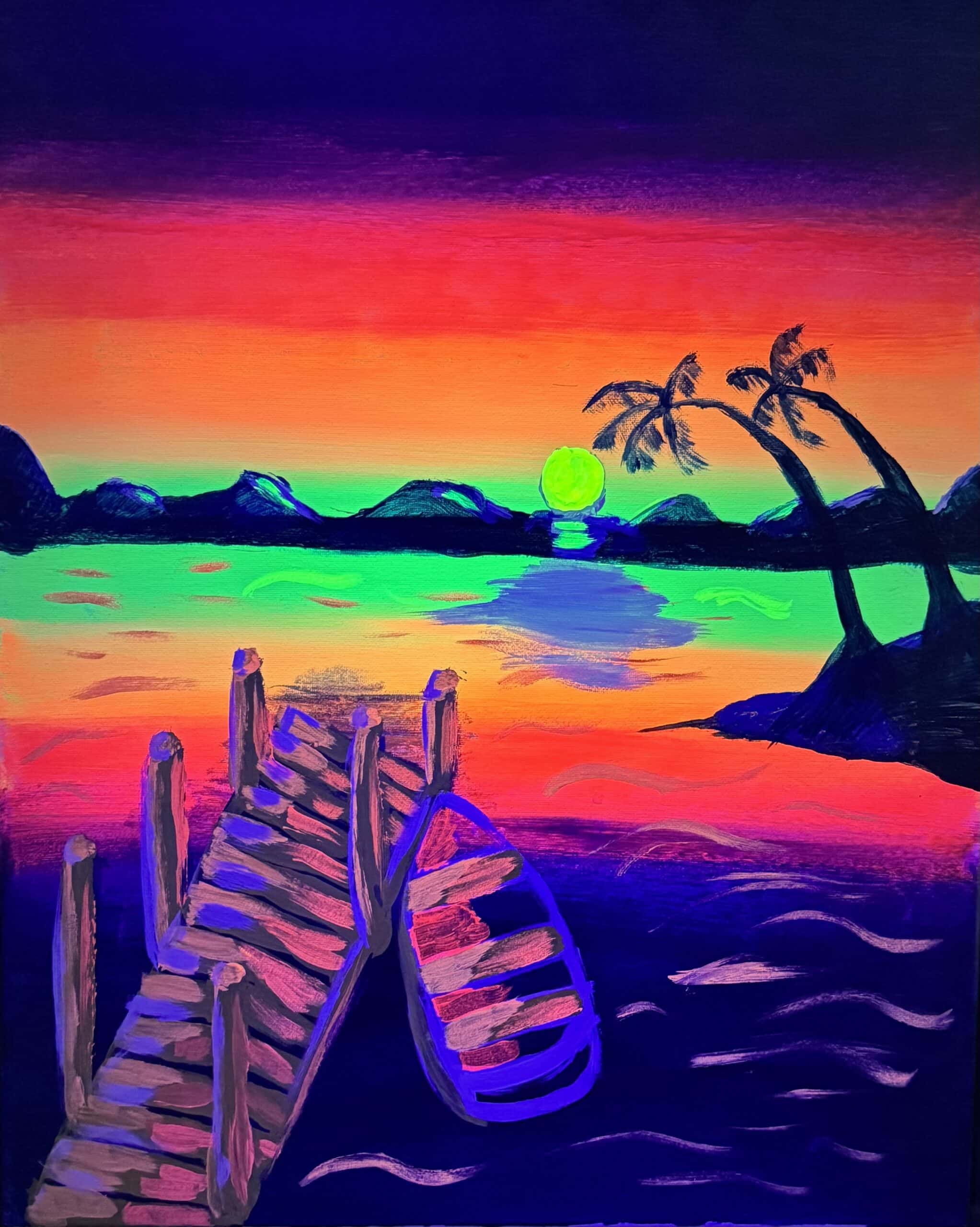
This sits next to my computer and I look at it every day. There are two reasons. First, the image gives me a goal to shoot for. Someday I want to look out my kitchen window and actually see this as my backyard. It’s one of my literal visions of success.
Second, it grounds me in leadership. This experience reminds me that a great leader has a crystal clear and exciting vision. They attract team members who want the same thing. They properly prepare them and give them everything they need to do a great job, setting them up for success. They trust them to get things done in their own way while offering unwavering and individualized support. They read the room and know when a break is needed, when batteries need to be recharged, and when to step on the gas.
And most importantly, throughout the project he continued to remind us that we should wash our brushes in the water and not the wine. Very important.
I have a feeling most leaders have lived a version of this. If you have, I’d enjoy hearing your take. And if you’re thinking through how to bring more clarity, trust, and consistency to your team, I’m always open to a conversation.


