

This article examines the concept of “value” from all sides and offers a deeper perspective that even the most seasoned salespeople will find eye-opening.
Gold? What Gold?
There’s a moment in business where you start seeing value before you see anything else. Who has it, who needs it, and how it moves between people.
It took me a long time to notice that pattern, and when I finally did, it explained a lot.
Years ago, I was introduced to this concept by a mentor of mine David Kauffman, author of Your Message. I now understand this concept to be the real Golden Rule. Not the school version. The practical one:
The person with the gold makes the rules.
What I eventually realized is that “gold” isn’t just money. It’s whatever is most valuable in that moment, like time, information, reputation, talent, access, deposits, trust, or even emotional buy-in. Whichever party had the more desirable “value” in the transaction, was the one who had the “gold”.
Once that clicked, I started recognizing how many decisions, negotiations, and relationships are shaped by value and emotion more than authority or intention.
When I was a young banker, I assumed the bank made the rules. We had the systems, the compliance, the disclosures, the pricing. But over time, I noticed how customers voted with their feet. When they felt respected, they stayed. When they didn’t, they quietly left. No announcement. No exit interview. Just an ACH transfer to somewhere that treated their gold a little better.
That’s when the Golden Rule started showing up everywhere.
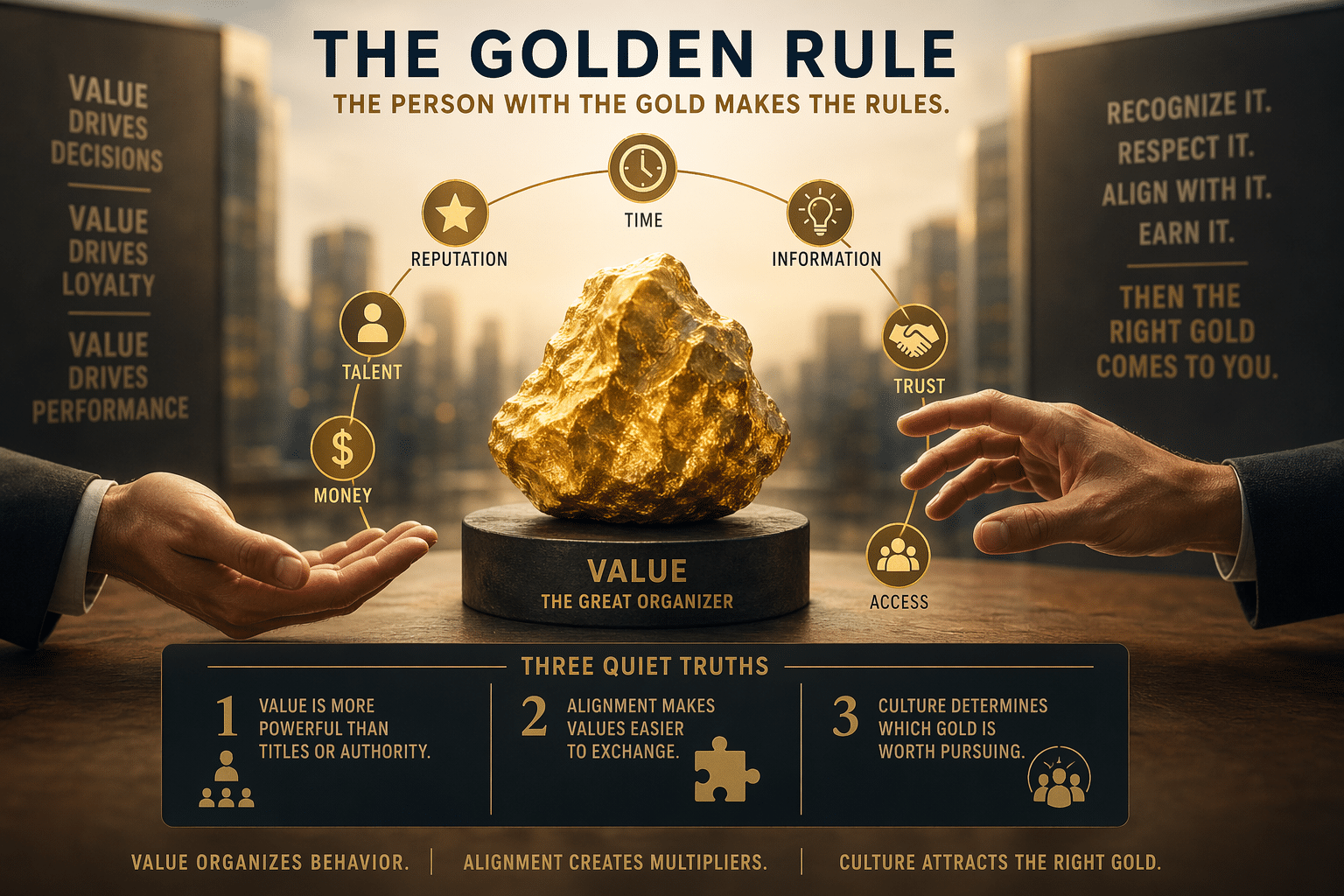
Value is the Great Organizer
I’ve watched the dynamic play out in leadership too. Employees bring their own kind of gold like talent, effort, customer experience, problem solving, emotional labor. Leaders who recognize that tend to get more of it. Leaders who don’t, eventually lose it.
There was a branch manager I worked with who never made big speeches about culture, but she understood who had the gold in different situations. She understood value at a human level. She listened, she cleared roadblocks, she celebrated wins, and she gave people room to grow. Her tactics with that team won her their loyalty. She earned their gold. They were loyal not because they had to be, but because they wanted to be.
What surprised me most over the years was how universal this idea is. Banking is just a clean example for me. But I’ve seen the Golden Rule show up in startups, family businesses, nonprofits, boardrooms, sports, and even parenting.
Anytime there’s an exchange, whether it’s money, belief, effort, or attention, the same mechanic shows up: value organizes behavior.
Now, here’s a second lesson that I learned much later in my career:
Not all gold is worth paying for.
When I was younger, I chased every opportunity. If someone had gold, I thought that meant I should go after it. I learned quickly that misaligned values create expensive relationships. A customer with high revenue but low alignment can drain an organization faster than they contribute to it. The same applies to employees, investors, and business partners.
Over time, I noticed that when values align, everything accelerates. Communication is clearer, service feels genuine, fewer conflicts, and culture becomes a multiplier instead of a drag. There’s less friction. Fewer surprises. And fewer rescue missions.
That realization pushed me deeper into a natural curiosity to understand culture, because I saw how culture shapes value and vice versa. A strong culture makes the right kind of gold easier to attract. Gold from customers who appreciate service, employees who take pride in their work, partners who think long-term instead of transactional.
Three Truths
Looking back, the Golden Rule ended up teaching me three quiet truths:
- Value is more powerful than titles or authority.
- Alignment makes values easier to exchange.
- Culture (the beliefs of a person or group) determines which gold is worth pursuing.
It applies in sales because value drives decisions. It applies in leadership because value drives loyalty. It applies in management because value drives performance.
Banking just happened to be the industry where I noticed it first.
Once I started seeing the world through that lens, conversations got easier. Not because I became more persuasive, but because I realized who had the gold in any given interaction.
The golden rule wasn’t something I invented. It’s something I was shown. And once I recognized its existence, I couldn’t unsee it.
If you liked this article and would like to talk further about your own sales, leadership, or company culture, we are a click away from meeting!


